Why Do Glazing Contractors Fail? The Hidden Cost of Construction Scope Gaps
Where a glazing package meets the roof, the slab edge and the temporary works
Recent insolvency figures suggest glazing is one of the more financially exposed construction trades. But the problem may reveal something much bigger about how the industry defines, prices and manages subcontract packages.
Having spent much of my career delivering large construction projects, one specialist trade that has always stood out to me for its commercial exposure is glazing.
Not necessarily because glazing contractors are poor at what they do. Quite the opposite. Many deliver highly sophisticated systems, often involving significant design, manufacturing, logistics and installation challenges.
The problem, in my experience, frequently arises at the boundaries of their work.
A glazing subcontractor might have a clearly defined scope for the permanent installation of a curtain walling system. But what happens when the adjoining structure isn't complete, the roofing contractor hasn't closed out the interface, or temporary weatherproofing hasn't been properly accounted for?
When water enters the building, damages internal finishes and disrupts follow on trades, the question of responsibility can quickly become a commercial dispute.
I've seen how these situations can create significant pressure on specialist contractors, particularly where the design, sequencing and contractual responsibilities haven't been properly established.
But is glazing really among the most financially vulnerable trades?
What the insolvency data tells us
An October 2026 analysis by VariationFlow, using UK Insolvency Service records and Companies House data, examined construction business failures across Great Britain in the twelve months to September 2026.
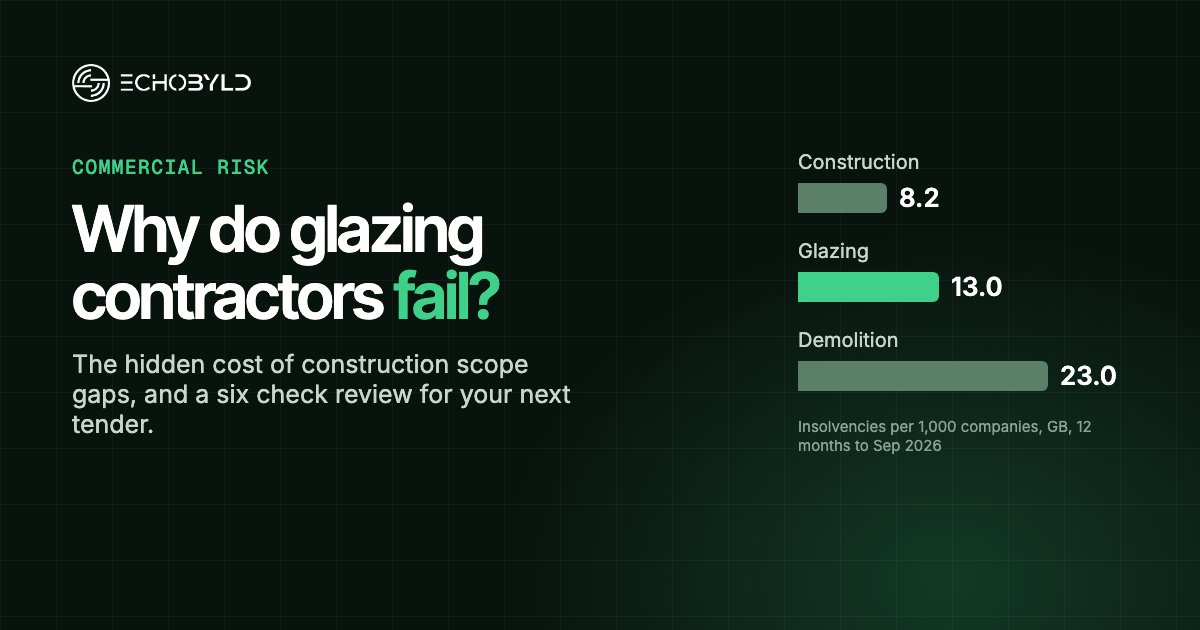
Across construction overall, the analysis recorded approximately 8.2 insolvencies per 1,000 active companies. For glazing companies, that figure was 13.0 per 1,000, about 58% higher, or roughly 1.6 times the construction average. Demolition recorded an even higher rate of 23.0 per 1,000, although that figure rests on only 28 business failures, so it is less certain.
| Construction overall | 8.2 |
|---|---|
| Glazing | 13 |
| Demolition | 23 |
Source: VariationFlow analysis of UK Insolvency Service and Companies House data (October 2026). Secondary analysis; it does not establish why businesses failed.
The results appear consistent with my experience that glazing is a particularly challenging specialist trade commercially. However, they need to be interpreted carefully.
This is an independent, secondary analysis of company registrations and insolvency records, not a study of why those businesses failed. It doesn't establish that water ingress, contractual disputes or scope gaps caused those insolvencies.
Closer to home, PwC's Q3 2026 Restructuring Update reported Irish construction insolvencies up 26% on the same period last year. Different market, same pressure.
The data does, however, raise an important question.
Are some specialist contractors carrying financial risks that are not fully recognised when their packages are designed, tendered and procured?
The interface problem: where does one package end and another begin?
Consider a typical curtain walling installation on a large commercial building. The glazing subcontractor has priced its package based on a set of drawings, specifications and tender requirements. The permanent system is designed to achieve the required structural, thermal and weather performance.
But during construction, the situation is different. The structural frame may be complete, while roofing, adjoining cladding, fire stopping and internal finishes remain at various stages of installation. At this point, temporary conditions become particularly important.
- Who provides temporary weatherproofing where the curtain wall meets the structure?
- Who ensures that an incomplete roof or adjoining façade does not allow rainwater to track behind the glazing system?
- Who maintains those temporary arrangements as work progresses?
- And if water penetrates the building and damages completed works, whose responsibility is it to investigate and rectify the damage?
These aren't always questions that can be answered by looking at the permanent glazing specification. The system may be correctly designed and installed, yet the building as a whole may not be watertight during construction. A dispute can arise even where the glazing subcontractor hasn't caused the original defect.
That doesn't automatically make the glazing contractor liable. Responsibility will depend on the actual cause, contractual obligations, design responsibilities, site records and applicable law. Nevertheless, investigating the issue, defending a claim, dealing with delayed payments or carrying out disputed remedial work can create financial exposure well before responsibility has been determined.
Research into building envelope defects reinforces the technical importance of these interfaces. A study in an American Society of Civil Engineers journal identified improper flashing, sealing and integration of weather resistive barriers among prominent defects associated with building envelope litigation. The Centre for Window and Cladding Technology also highlights the importance of competent installation, supervision and checking of cladding systems.
This isn't simply a glazing problem. It's a coordination problem.
The same risk exists across almost every major subcontract package
Groundworks. A subcontractor prices excavation and drainage based on the tender information, only to discover that temporary dewatering, unsuitable material disposal or additional ground treatment hasn't been adequately defined. The work must still proceed, but its commercial treatment may be contested.
Structural steel. The fabricated frame may be fully measured and priced, while responsibility for temporary stability, access arrangements, connection design or fire protection interfaces remains unclear.
Mechanical and electrical. Containment, builders' work openings, penetrations, fire stopping, testing and commissioning overlap with other packages.
In each situation, the underlying problem is remarkably similar.
The permanent works are relatively easy to identify. The activities required to connect, protect, coordinate and complete those works are often less obvious. And it is those activities that can undermine the assumptions on which a tender price was built.
What wider construction disputes tell us
HKA's ninth CRUX Insight report, published in 2026, examined claims and disputes across 2,410 construction and engineering projects worldwide, with a combined capital value of approximately US$2.56 trillion. Design related failures were identified on 40.5% of projects in the dataset, while scope change was blamed for disputes on 33.4%.
These figures do not mean that every such project was badly managed. Large, technically complex projects will always involve uncertainty. But they illustrate how often incomplete information, changes and coordination failures become commercial issues.
There is an important distinction between a project changing legitimately during construction and a project discovering that necessary work was never clearly allocated in the first place. The former should be managed through an agreed change control process. The latter can become far more contentious.
A scope gap frequently appears only when somebody needs to carry out the work. By that stage, the programme may already depend on it, the contractor may have limited alternatives and the commercial discussion becomes reactive rather than planned.
Why these problems are difficult to identify at tender stage
Construction estimating traditionally focuses on measuring and pricing identifiable work. Drawings are reviewed, quantities are extracted, specifications are checked and rates are applied. That is essential. But a comprehensive bill of quantities does not, by itself, guarantee that all responsibilities between trades have been properly allocated.
- An estimator might identify every square metre of curtain walling without resolving who supplies the temporary weatherproofing required during the installation sequence.
- A groundworks QS might accurately measure excavation volumes without establishing who bears the cost of temporary water management under the assumed construction method.
- An M&E contractor may price every service run while leaving responsibility for penetrations and their fire stopping unclear.
The quantities can be correct while the commercial scope remains incomplete. A scope gap is not always an unmeasured quantity. Sometimes the quantity is known, but the responsibility, the temporary condition, the construction method or the commercial allowance is not.
That is why scope validation needs to go beyond measurement. It needs to consider what the drawings show, what the specifications require, what the construction sequence demands and what the contractual package actually includes.
A practical tool: the Interface and Scope Gap Review
Rather than general advice, here is the framework I'd use to assess a real subcontract package before it is priced or let. Six checks, one question each.
| Check | Question to resolve | Glazing example |
|---|---|---|
| Permanent works | Is the complete scope defined? | Glazing frame, seals, brackets |
| Package interfaces | Who owns each connection? | Glazing to roof waterproofing |
| Temporary conditions | Who designs, provides and maintains protection? | Temporary rainwater barriers |
| Sequence | Is the priced scope compatible with the programme? | Façade installed before roof closure |
| Commercial ownership | Is the work priced, included or expressly excluded? | Temporary waterproofing allowance |
| Verification | Who inspects, accepts and records completion? | Joint interface inspection |
1. Review the interfaces, not just the individual packages
Every major subcontract should be considered alongside the packages it connects to. For glazing, that may include the structure, roofing, cladding, waterproofing and internal finishes. For M&E, it may include builders' work, fire stopping, ceilings, structural openings and commissioning. An interface responsibility matrix identifies who designs, supplies, installs, protects, inspects and signs off each interface.
2. Identify temporary works and temporary conditions early
Weather protection, access, temporary supports, dewatering, protection of completed works and sequencing constraints should be identified before the subcontract is agreed. Where temporary protection is required, the scope should also establish who maintains it, when it can be removed and who authorises that removal.
3. Record assumptions, exclusions and unresolved design information
If the tender information doesn't explain an interface, record the uncertainty. A provisional allowance, a clarification request or an explicitly assigned responsibility is better than assuming another contractor has included the work. The objective is not to transfer every risk to the subcontractor. It is to make sure necessary work has been recognised and commercially addressed.
4. Check the construction sequence against the priced scope
A permanent detail might be perfectly adequate in the completed building but insufficient during construction. Review how the work will be delivered, what will be exposed at each stage and which temporary measures will be needed. This matters most for complex façades, basements, structural alterations, large M&E installations and projects with overlapping packages.
5. Keep scope, cost and responsibility connected through delivery
Even a well defined tender package will evolve. Design information changes, site conditions emerge and sequencing is revised. Those changes need to be recorded against the original agreed scope, with clear ownership, commercial treatment and supporting evidence. Otherwise, assumptions understood at tender stage gradually become unresolved disagreements on site.
The bigger issue isn't which trade fails most often
Glazing may stand out in recent insolvency statistics, and it certainly reflects some of the commercial risks I've encountered during my career. But the wider lesson is not that glazing subcontractors are uniquely vulnerable. It's that every contractor can become exposed when the work needed to deliver a project is not fully recognised, allocated or priced.
Construction projects are rarely unsuccessful because somebody forgot to measure an obvious wall or slab. Some of the most difficult commercial problems arise in the spaces between clearly defined activities: the temporary conditions, incomplete details, overlapping responsibilities and assumptions that never make it into the final subcontract.
Better quantity information is part of the solution. But better scope definition, interface coordination and commercial visibility are equally important.
Construction projects don't just lose money on what they get wrong. They lose money on what nobody realised they were responsible for.
Research and references
- VariationFlow (October 2026), Construction insolvency by trade: which trades go bust most often in Great Britain (12 months to September 2026). variationflow.com/research/construction-insolvency-by-trade-2026
- UK Insolvency Service, Company Insolvency Statistics, September 2026. gov.uk/government/statistics/company-insolvencies-september-2026
- HKA (October 2026), CRUX Insight Ninth Annual Report: Powering Through Uncertainty. hka.com/news/crux-insight-ninth-annual-report-powering-through-uncertainty/
- Centre for Window and Cladding Technology, Construction and Installation Guidance. cwct.co.uk/pages/construction
- VanDemark, Clevenger and Click (2021), Building Envelope Issues within Construction Defect Litigation, ASCE Journal of Legal Affairs and Dispute Resolution in Engineering and Construction 13(4). doi.org/10.1061/(ASCE)LA.1943-4170.0000484
- PwC Ireland (October 2026), Restructuring Update, Q3 2026. pwc.ie/media-centre/press-releases/2026/restructuring-update-q3-2026.html
Need help with your project?
Start with a project analysis or book a consultation to discuss your next steps.